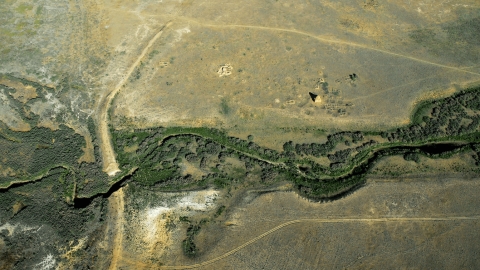
This complex is one of the archeological monuments of the ancient Stone Age of Kazakhstan. Toleubulak petroglyphs are located in Mugalzhar district of Aktobe region, 13 km north-east of Bulakty village, near Toleubulak wintering ground. The petroglyphs of the cave were discovered in 2000 by a joint international Kazakh-Russian expedition to study the Stone Age settlements in Mugalzhar district (leaders: Academician of the Russian Academy of Sciences, archeologist A.P. Derevyanko, Professor V.T. Petrin, Zh.K. Taimagambetov, etc.). , introduced into science. In 2006, a specialist of the Institute of Archeology named after A. Margulan, Candidate of Historical Sciences Z. Samashev conducted research.The monument is an ancient painting (petroglyphs) in the cave Toleubulak near the Mugalzhar Mountains in the upper reaches of the river Zhem. The Toleubulak monument was considered a sacred place in the life of the first society and may have served as a coffin (for the cave to perform rituals related to fertility and water properties). This is evidenced by the pictures at the bottom of the cave, which are 6 cm deep and 17-25 cm in diameter. In a small cave there are petroglyphs, anthropomorphs and deep lines resembling hooves and mushrooms. Scientists believe that the above symbols may be common in the Paleolithic, Mesolithic and Neolithic.Toleubulak cave and its surroundings have been of interest to people since ancient times. Near the monument, there are workshops with Paleolithic sites and stone artifacts.
Reference: 1. Regional sacred sites of Kazakhstan. –Astana: Foliant, 2017. –124 p .; 2. The sacred Kazakhstan. Volume 2 –Astana, 2018. –117 p.