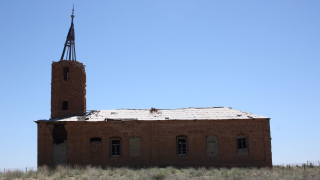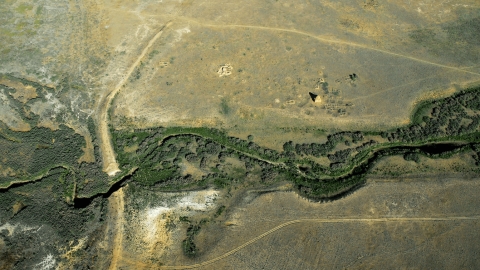
Balgasyn is an ancient burial ground preserved from the Middle Ages, a monument of architecture. Aktobe region is located 55 km north of the modern city of Shalkar. The cemetery was studied in the late XIX and early XX centuries by members of the Orenburg Scientific Archive Commission A. Matov, I. Khokhlov, Zh. Castagne, in 1979-1980 an expedition of the Ministry of Culture of Kazakhstan (headed by S. Azhigaliyev). The cemetery consists of the remains of the Balgasyn tower, the mausoleum of Onalbek Ata (about XVII-XVIII centuries) and many tombs built of raw brick and slate.
The tower has long been considered a monument of the Kipchak era. As a result of research by the expedition of the Ministry of Culture of Kazakhstan, it was determined that the Balgasyn tower was built in the late XV and early XVI centuries of the Kazakh-Uzbek-Nogai epoch. In the descriptions of the tower before the fall (1900), especially in the painting by A. Matov (1897), the mausoleum clearly shows the features of the school of architects in the time of Amir Temir. The hammer tower is made of high quality baked brick and the dome is covered with blue enamel. The architecture of the Hammer Tower shows a compositional connection with the Mauerannahr and Desht Kipchak memorials.Archaeological excavations at the Balgasyn Tower in 2005, uncovered ceramics, pottery fragments, beads, rosaries, arrowheads and a 5-tiyn Russian coin dated 1859, a brick -kiln was found 400-500 m away. According to local legends, Balgasyn was built by his father at the burial place of an unknown pious girl. According to the second legend, the tower grew out of the ground by itself in three days. According to the third legend, the mausoleum was built of five thousand Tatars mixed with clay and mother's milk, made of baked bricks and left in an unknown direction. Ancient sources prove that the Kazakhs considered the monument to Balgasyn as sacred. Women who could not conceive believed that if they spent the night at the mausoleum and had a good dream, they would have a baby.
Reference: 1. Regional sacred sites of Kazakhstan. – Astana: Foliant, 2017. –131 p .;
- Sacred Kazakhstan. Volume 2 – Astana, 2018. –39 p.