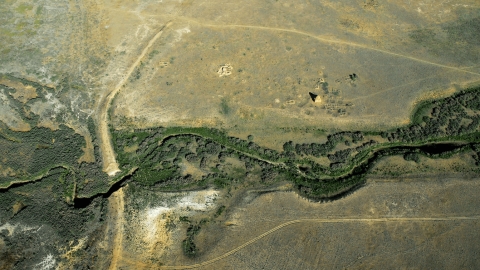
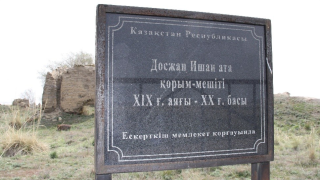
The Blue Mosque (early twentieth century) is a complex of mosques, madrassas and houses. It is located in Or village of Mugalzhar district of Aktobe region. According to locals, the complex was built in 1902-1905 with funds raised from the Tama tribe, which is why the mosque is called the “Blue Mosque of Tama”. Initially, it was planned to build a mosque elsewhere, however the place was chosen since the voice was heard properly here.
This lone mosque on the Elek, Or, and Zhem rivers is a rectangular, one-story building that stretches from north to south. The foundation of the building is made of stone, the walls are made of treated black stone and clay. The roof of the building is covered with wooden beams, and the roof is covered with flat sheet metal. The general madrasah consists of four doors and seven window openings (one window on the east side turned into a door). At the opening ceremony of the mosque, Elder Tama Kosuak blessed for about an hour and a half. Tobazhan, who received his religious education from Bukhara, was the first imam of the mosque. People called him Sary Ishan. Tobazhan Ishan's voice was so loud that when he called for the morning prayer, his voice could be heard 15-20 km away.
All the residents of Emba and Ashysai villages went to the Blue Mosque for Friday prayers. During the Soviet era, Belyakov and Boranbay, the mosque's rulers, tore down the mosque's dome and dome with a tractor. But less than a year later, they both died with their entire family.
Currently, the walls of the mosque, which have been the heritage of our ancestors for centuries, are preserved intact. Near the mosque there is a stone madrasah where children once studied.
Reference: Regional sacred sites of Kazakhstan. –Astana: Foliant, 2017. –123 p; 2. The sacred Kazakhstan. Volume 2 – Astana: 2018. –109 p.