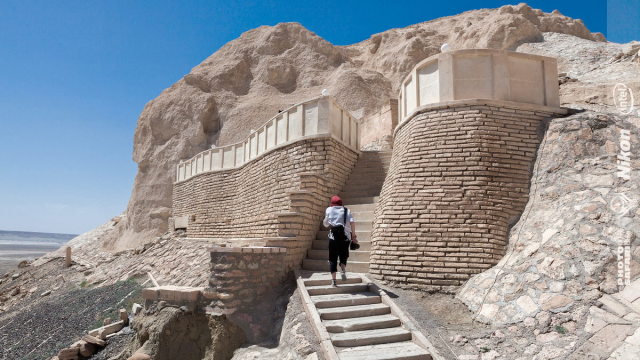
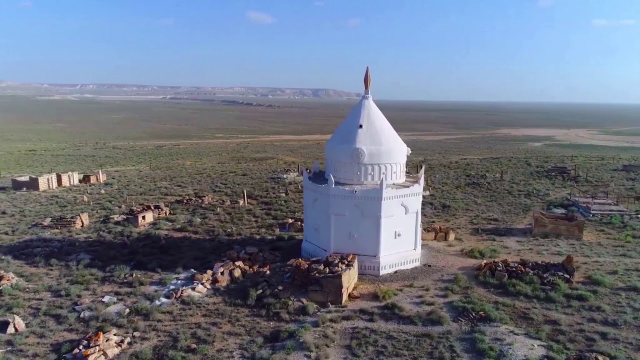
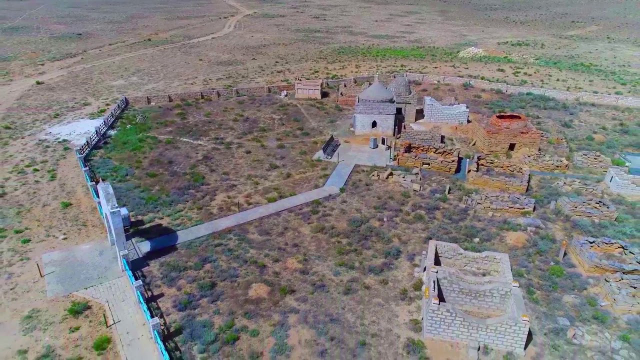
Makhtum Baba Mosque is a complex located 25 km east of Fort Shevchenko, Tupkaragan district, Mangistau region. In ancient times, this place was called Kanga Baba gorge.The Kanga Baba gorge was an important place on the caravan route from the port of Mangyshlak to Khorezm and Khiva. It has attracted the attention of many travelers and researchers. The complex of monuments is located on the southern slope of the Ustyurt, which is suitable for ancient settlements and gradually turns into a wide valley. Most of the complex (central and eastern part) is covered by ancient Turkmen monuments - mainly stone signs, tombs in the form of "sheep"; box-box; slate fences with built-in tombs; There are also stone signs with candlesticks.Makhtum Baba Mosque was used as a caravanserai building in the Kipchak-Oguz period, and in later centuries it was a school-madrasah. The mosque was a multi-chamber building with large and small rooms.Saint Makhtum Baba, a descendant of Imam Hussein, came to Mangyshlak from the former Persian land inhabited by the Kurekal Turkmens. Soon the disciples began to come to him, and there were many of them. At that time there were no trees in the Kanga area. One day the disciples came to Makhtum Baba and asked for permission to walk in the garden. In response, Makhtum Baba said: “Do not go anywhere today, if you can not find a garden nearby until tomorrow, I will allow you to enter the garden”. The disciples obeyed him, and the next morning they saw that the whole mountain was full of trees. Surprised by this miraculous sight, they came to Makhtum Baba, fell at his feet, and repented of their sins. After that, the number of Makhtum Baba's disciples increased to several thousand. After the death of Makhtum Baba, the gardens were destroyed and only a few mulberry trees have survived.
References: 1. Kazakhstan sacred objects
of whole national importance. – Astana: Foliant, 2017. –345-p.; 2.The sacred Kazakhstan. Volume-2. –Astana: 2018. –359-p.