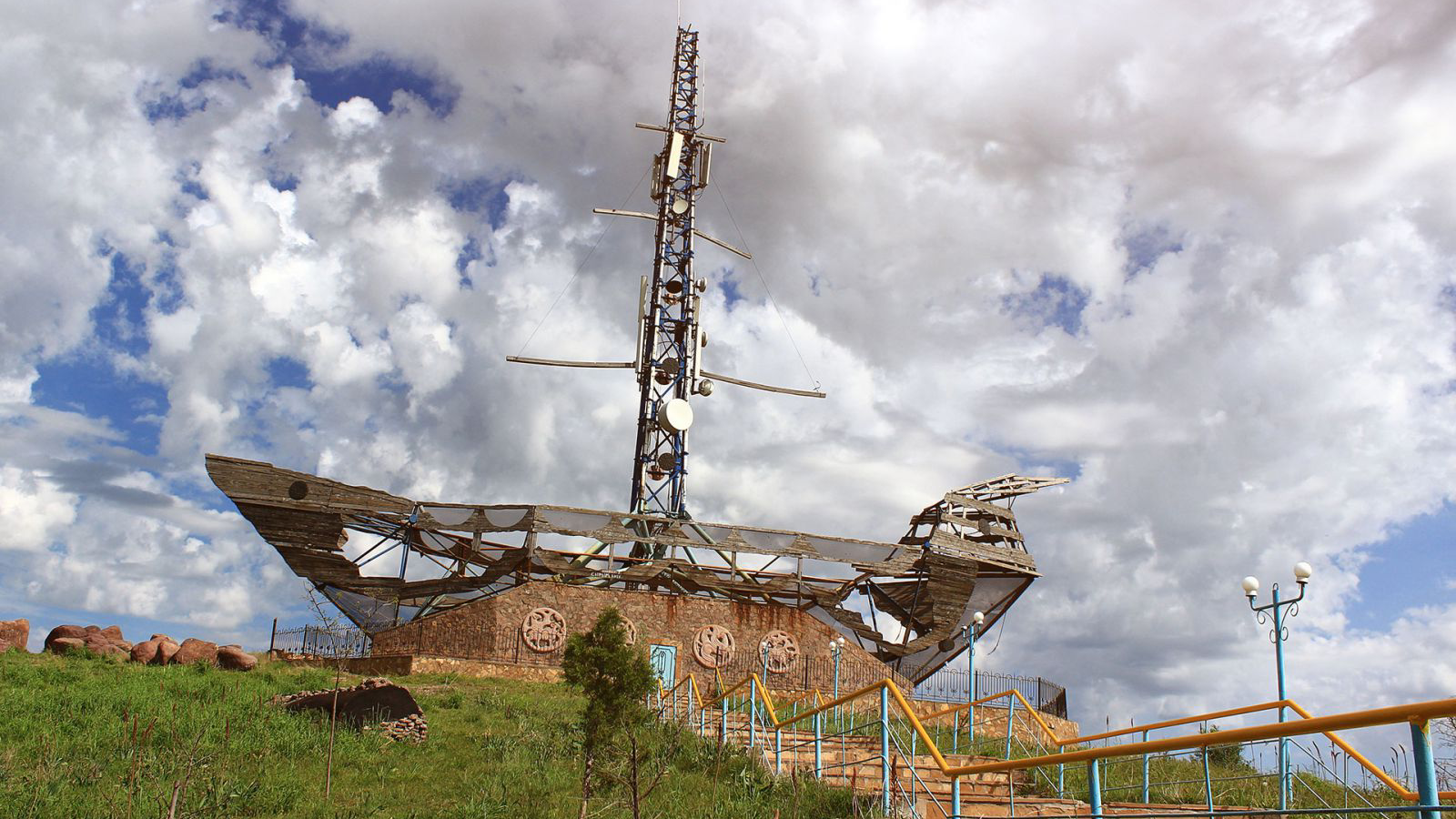
The complex is located 35 km south of Shymkent, the center of the South Kazakhstan region. One massif of Talas Alatau Kazygurt is 1800 meters high, 20 km long and 10 km wide.
There are many religious myths in world mythology about the “Holy Mountain”, “the world flood”, “Noah's ark”. They are mainly from the Jewish, Christian and Islamic originals. The Kazakh mythological version, based on Islamic parallelism, “There is a ship at the head of Kazygurt” has its own peculiarities.
First, the fact that Noah's ark landed on the top of the mountain is controversial. Because, according to Islamic principles, there should be no arrogance to say, “I am above all”. But the name of the mountain is a mountain, and the ship stopped there, and although it is low, it is considered the holiest of the mountains on earth.
Secondly, it is said that the offspring of the four survivors of the flood grew and multiplied from the head of Kazygurt.
Thirdly, it should be noted that the microtoponyms associated with the ark of Noah are closely related to Kazygurt. On the western side of the top of Kazygurt mountain there is a less flat land. This place is called "the rest of the ship". There are toponyms such as “Noah's Ark Trail”, “Cave where Noah and the people around him lived” after the flood, “The place where the Prophet prayed”, “Five fingerprints” in the cave, “Spring drinking water”.
Fourth, Kazakh mythology says that “when God first created the earth and the sky, the mountain Kazygurt was created together”. Even before the “Noah's Ark” stopped, Kazygurt was visited by saints, so it is interpreted as a “sacred mountain”.
Reference: Kazakhstan sacred objects
of whole national importance. – Astana: Foliant, 2017. –36-38 pp.