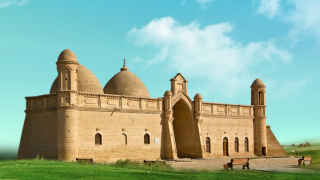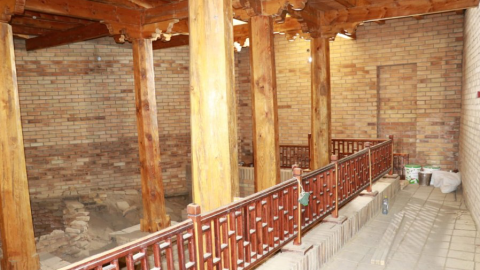
The Great Kyluet is a historical place associated with the life of Hodja Ahmed Yassavi, an underground place, the center of Sufism in the XII century. monument.Hodja Ahmed Yassavi, who reached the age of prophethood (63 years old), went underground and spent the rest of his life in this "Kyluet". Kyluet is one of the semi-underground religious buildings, built in the XII century and operating continuously until the first half of the XX century.According to scholars, the word “kyluet” comes from the Arabic word "haluatun", which means isolation, isolation from the world, a place of worship in solitude. K.A. Yasawi made many disciples in this Kyluet and wrote his works like Diwani Hikmet.Located 150 m from the Yasawi mausoleum, the building is large, with a flat roof and two doors. The underground mosque has three doors. The total number of rooms is 18. Kyluet consists of rooms for religious ceremonies and household chores. The place of worship was built in several stages, the oldest part of which is the Gar (XII century), a small room with a depth of 4 m. The walls and dome are made of square bricks, woven with the ancient “melt” system. The walls have small cavities for candles. It is connected to the prayer hall by a narrow staircase. The last hall is a four-room house with a ventilated roof. Archaeological research shows that small and medium-sized halls were built in the second stage of construction (XV-XVII centuries), and other buildings in the XVIII-XIX centuries. built.
Reference: Kazakhstan sacred objects
of whole national importance. – Astana: Foliant, 2017. –210 pp.